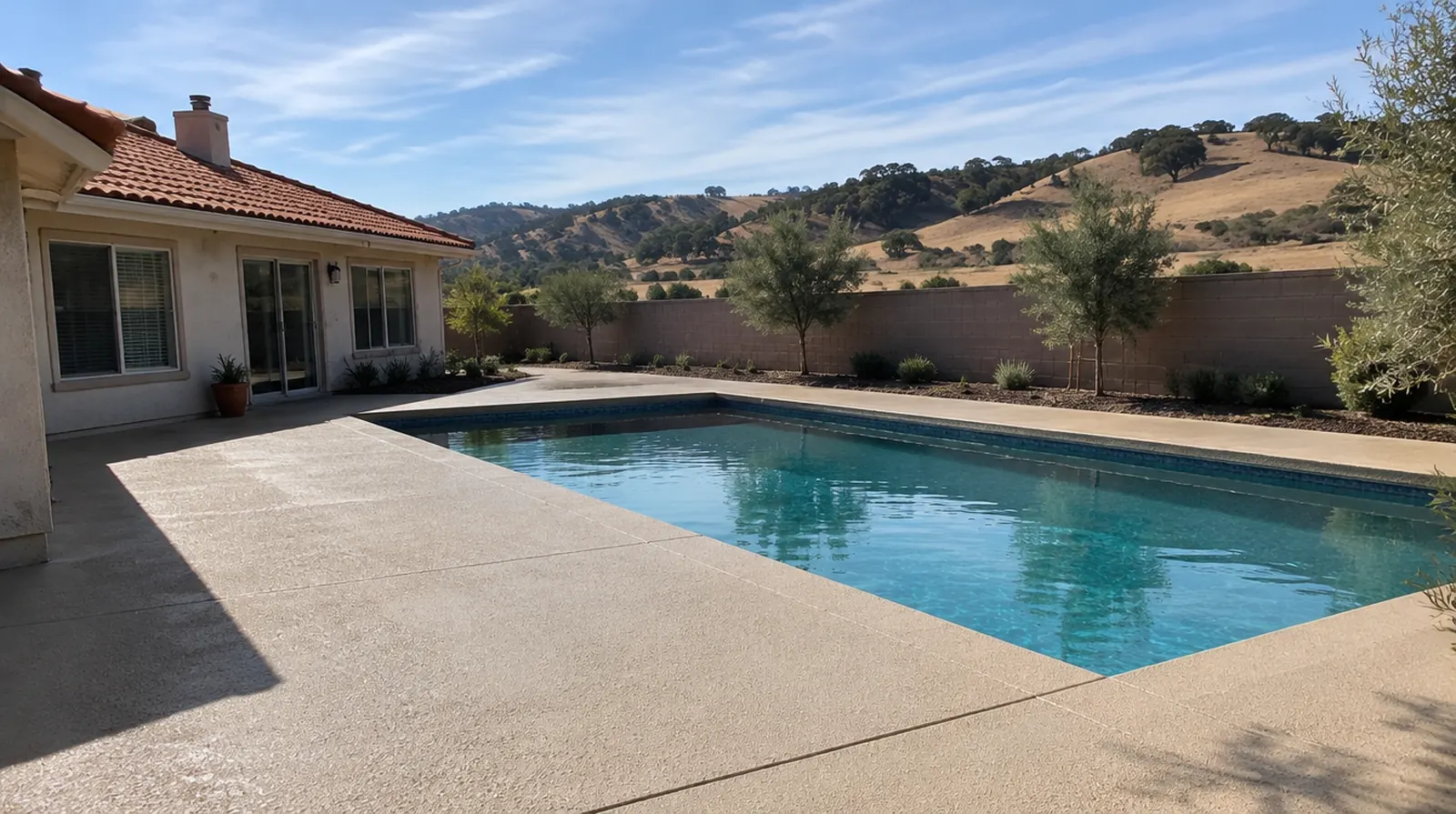
What the Santa Maria Valley does to a pool deck
The Santa Maria Valley opens straight to the Pacific, and that shapes almost everything about outdoor concrete here. Most days start under a cool marine layer that leaves decks damp until late morning. By early afternoon the sea breeze kicks in and blows steadily down the valley, often hard enough to rattle patio umbrellas. That wind carries fine sand and field dust, and it settles into every pore of a bare or worn deck. Summer heat is mild compared with inland California, but the sun is strong, and UV breaks down cheap deck paints and acrylics faster than most people expect.
The result is a pattern we see across town. Decks get gritty and stained, old paint peels in sheets where moisture works underneath, and smooth, sealed concrete turns slick when the morning fog leaves a film on it. A good coating has to handle all three: grit, damp and sun.
Homes and pools we see around town
Santa Maria has grown in waves, and the pool decks tell you when each house was built.
- Older central neighborhoods have mid-century homes with small backyard pools and decks that have been painted or patched several times. These usually need the most prep.
- Orcutt and the south end have many 1980s and 1990s stucco homes with tile roofs and larger lots. Their decks are often original broom finish or a worn spray texture, with cracks along the edges of the slab.
- Newer tracts on the edges of town have newer pools, often with pavers or plain concrete that just needs a protective, cooler finish.
Much of the valley sits on sandy, well-drained soil. That is good news for decks, since it does not heave the way expansive clay does, but areas near old orchards and fields can settle unevenly. Cracks that run in a straight line from a corner are normal shrinkage. A crack with a raised lip is a sign the slab has moved, and we will tell you about it before we coat over it.
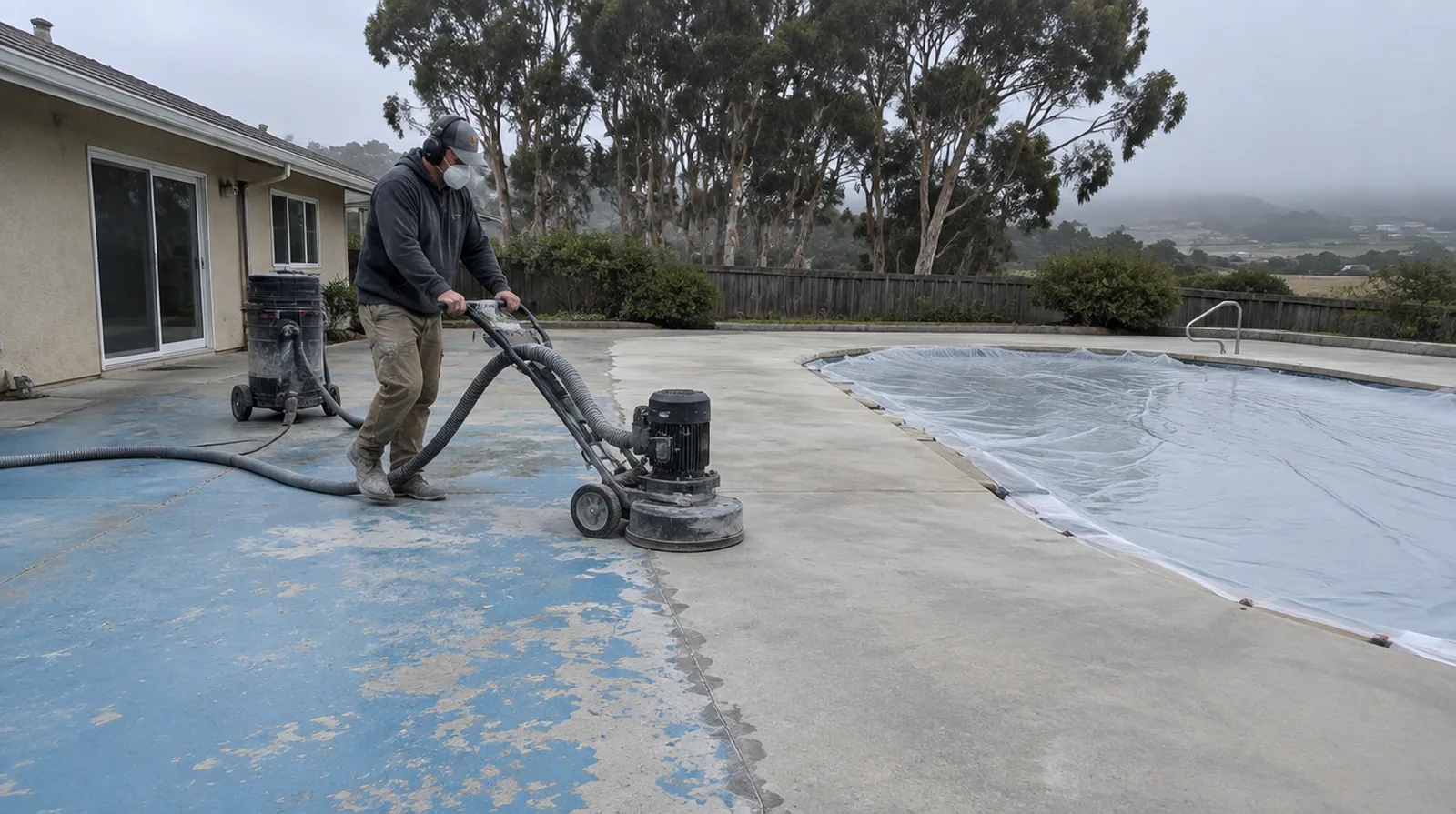
How we coat a deck here
Test and strip. We scrape and tape-test any existing coating. If it lifts, it comes off, because a new finish is only as strong as what it sits on. Most painted decks in town get ground down to bare concrete.
Repair. We route and fill cracks with a flexible filler, patch chips at the steps and coping, and keep control joints as joints so the slab can move without telegraphing new cracks.
Build the texture. After priming, we apply a textured system, usually a spray knockdown or a broadcast-sand finish, and seal it with a UV-stable topcoat. We add fine grit to the topcoat so the surface stays grippy on fog-damp mornings and when the kids are dripping wet.
Protect the pool. The water stays in. We cover the pool, mask the tile line and coping, and keep overspray off fences and planters, which matters when the afternoon wind picks up.
Picking a finish for coastal light
Lighter colors stay cooler and hide dust and blown sand better than dark ones. Sandstone, light gray, buff and warm tan are the most popular choices around Santa Maria, and they sit nicely next to the stucco and clay tile on so many homes here. Darker tones show every footprint once the wind has been blowing.
If your deck is newer and in good shape, you may only need a quality penetrating sealer. Our concrete sealing service protects bare concrete for less. For a side yard, patio or driveway that ties into the pool area, we also do driveway coatings in matching colors.
Timing your project
Because the valley rarely gets very hot or very cold, we can coat decks most of the year. The main limits are rain, which mostly falls between November and March, and the morning dampness. We schedule work to start once the marine layer burns off, and we keep an eye on the wind forecast so coatings are not sprayed in a gust. A typical residential deck takes three to four days from prep to the last topcoat, and you can walk on it barefoot after about a day.
Care after the job
Rinse the deck with a hose every week or two to clear sand before it gets ground in. A soft brush and mild soap handle most stains. Keep pool chemicals off the surface as you add them, and hose off any spills. Every few years, a fresh topcoat keeps the color bright and the grip strong, especially on the sunny south and west sides of the pool.
Common questions
Do you work outside the city? Yes. We coat decks in Orcutt, Nipomo, Guadalupe and the surrounding valley.
Will the coating be slippery when it is foggy? Not with the grit we add. The texture and topcoat are designed for wet feet.
Can you coat over pavers? Sometimes, but pavers move. We will tell you honestly whether a coating will last on yours.
Ready for a deck you can walk on barefoot?
Call (805) 362-2565. We will look at your deck, test the old coating and give you a written price.